About the Author…
.JPG)
Constance Kurash OTR/L, CHT, (Connie) offers over 25 years of experience providing specialty therapy services to the hand and upper extremity. Connie began her medical career in Pittsburgh PA in 1991 moving to Florida in 1997. Connie specializes in the treatment of numerous hand and arm injuries as well as dysfunction. She also enjoys teaching and sharing her orthotic designs, lecturing at professional seminars discussing the articles and book chapters on hand therapy topics she has authored for various publications. Connie has received a high degree of recognition and numerous awards for her expertise in splint designs. She has been on numerous medical missions trips accompanied by specialists in hand surgery, orthopedic surgery and pediatric congenital deformity.
Connie also shares her time off volunteering for her community helping to build off-road bike trails for mountain biking.
“ I would like to dedicate this on-line book to my sister, Julia, who is an RN. She babysat me on my first medical missions trip”. “ I would like to thank my twin sister, Karen, for drawing the illustrations for this book and thank my brother, Reed, for his expertise on the OI chapter. All of my family members helped with this book in some way. Another big thank you to Dr. Bob, for always being so kind and teaching all of us on the missions trips. Dr. Bob has an enormous amount of patience and expertise for screening, decision making, and surgical intervention for the numerous complicated cases we see in the underdeveloped countries.”
“All photos received the implicit consent of parents and or legal guardians of all individuals for educational purposes. The names have been changed of all individuals to protect and preserve the integrity of their identities. Because of language barriers due to the multiple languages spoken and the many illiterate guardians and or parents, an interpreter was present for each and every consent received.”
Learning Objectives:
- Determine 5 reasons for different congenital deformities
- Identify 11 different congenital deformities
- Determine how to evaluate rare deformities
- Visualize the problem solving and photos of fabricating custom orthotics
- Review key facts about congenital deformities which will be used for therapeutic intervention.
- Visualize surgical intervention techniques utilized to correct congenital deformities
Days 24-27: Onset of development of arm bud.
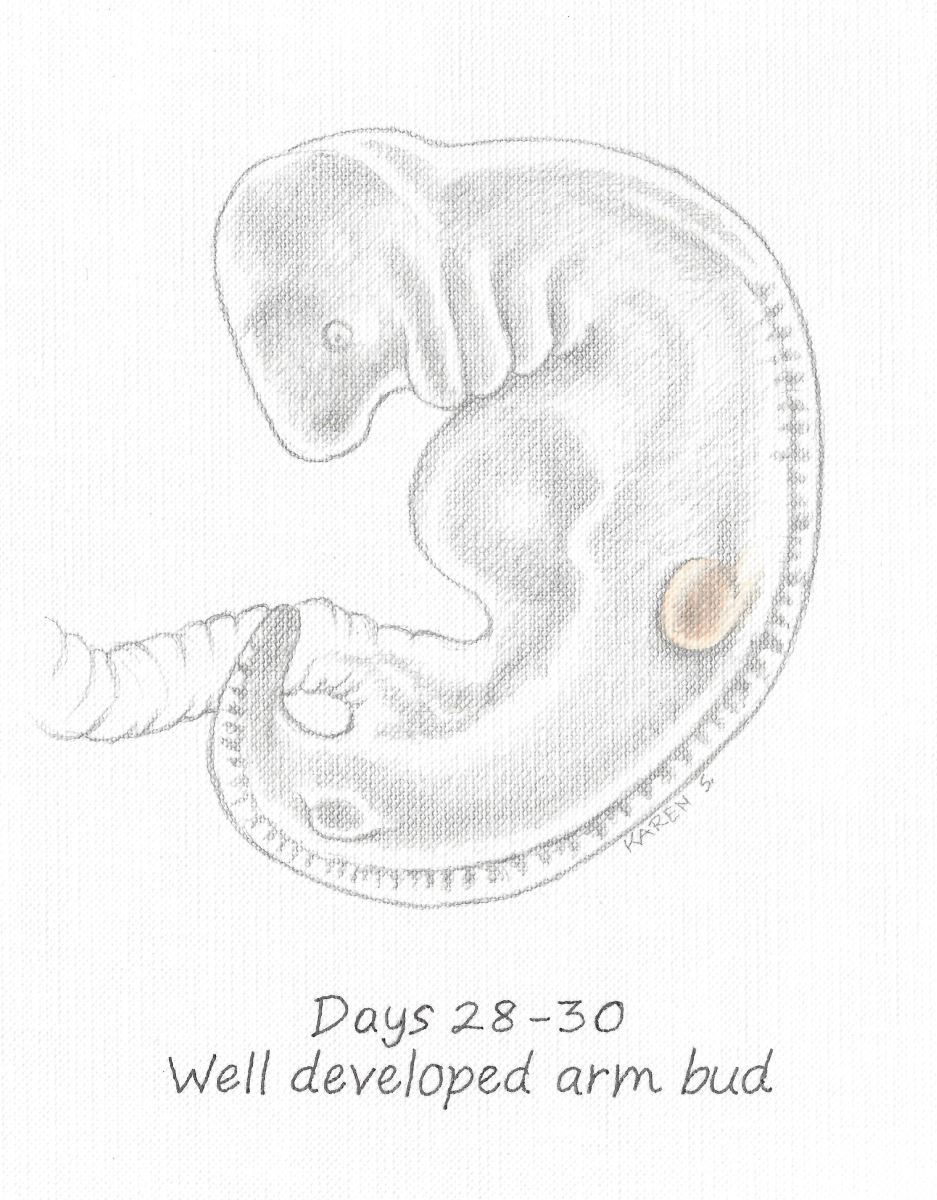
Days 28-30: Well developed arm bud. The upper limb buds are visible. The limb buds elongate by the proliferation of mesenchyme which condenses to form cartilage, bone, and connective tissue. The apical ectodermal ridge is a major signaling center that is necessary for the elongation of the limb to occur.
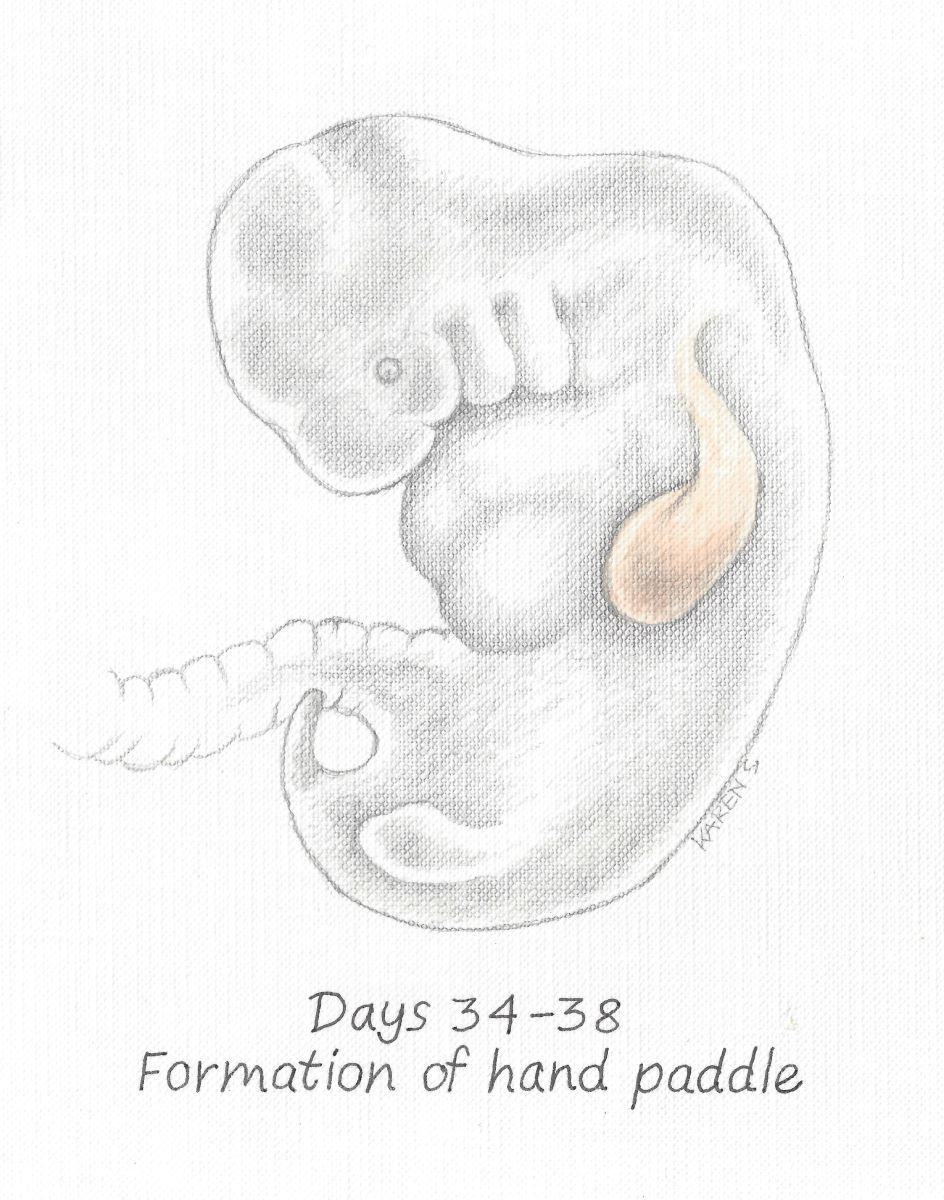
Days 34-38: Elongation of arm bud and formation of hand paddle. Elongation begins and the limbs that appeared as a flipper now can be seen as as paddle shaped hand plate.
Day 41: The hand plate begins to delineate into digital rays.
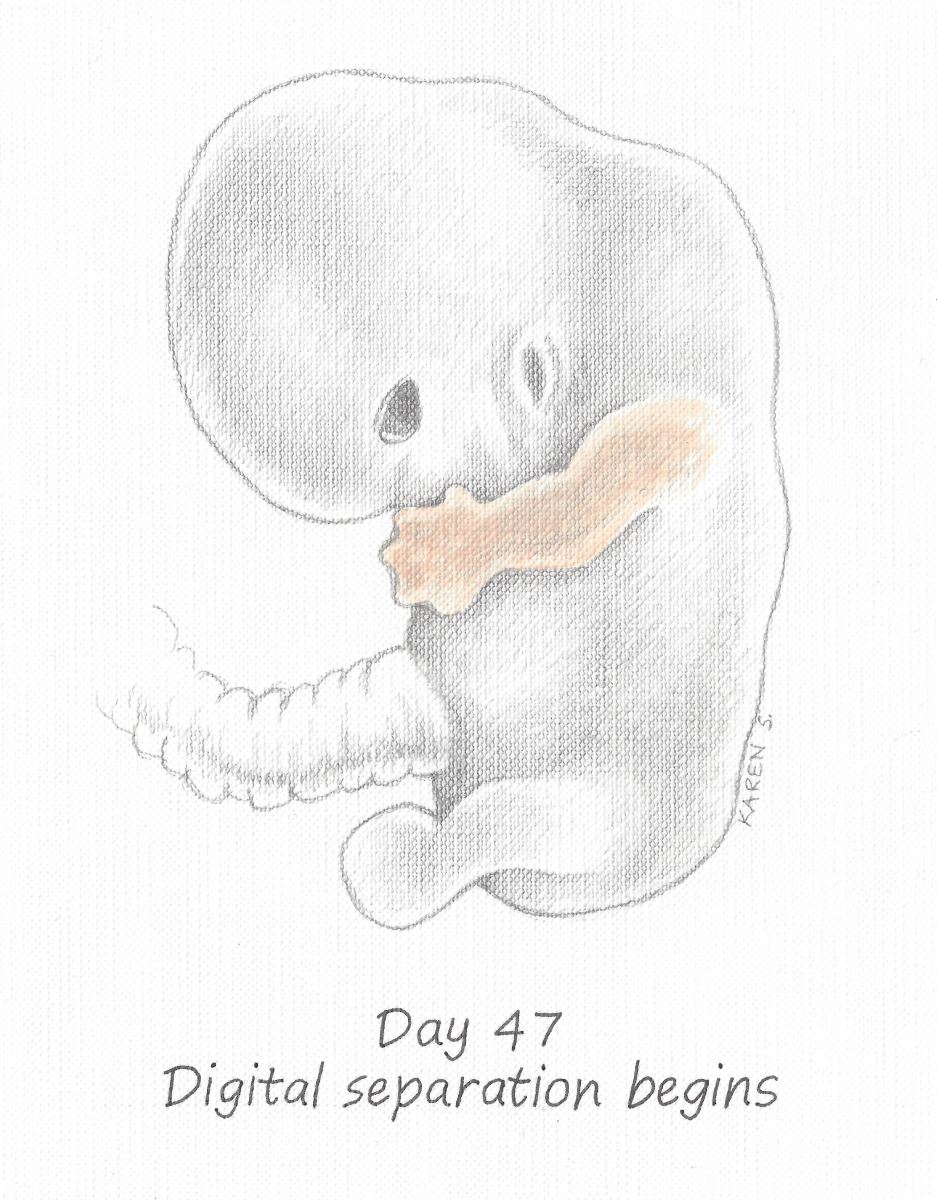
Day 47: Digital separation begins. Apoptosis (the process of programmed cell death) is necessary for digital separation to occur.
Day 50: Digits are still webbed.
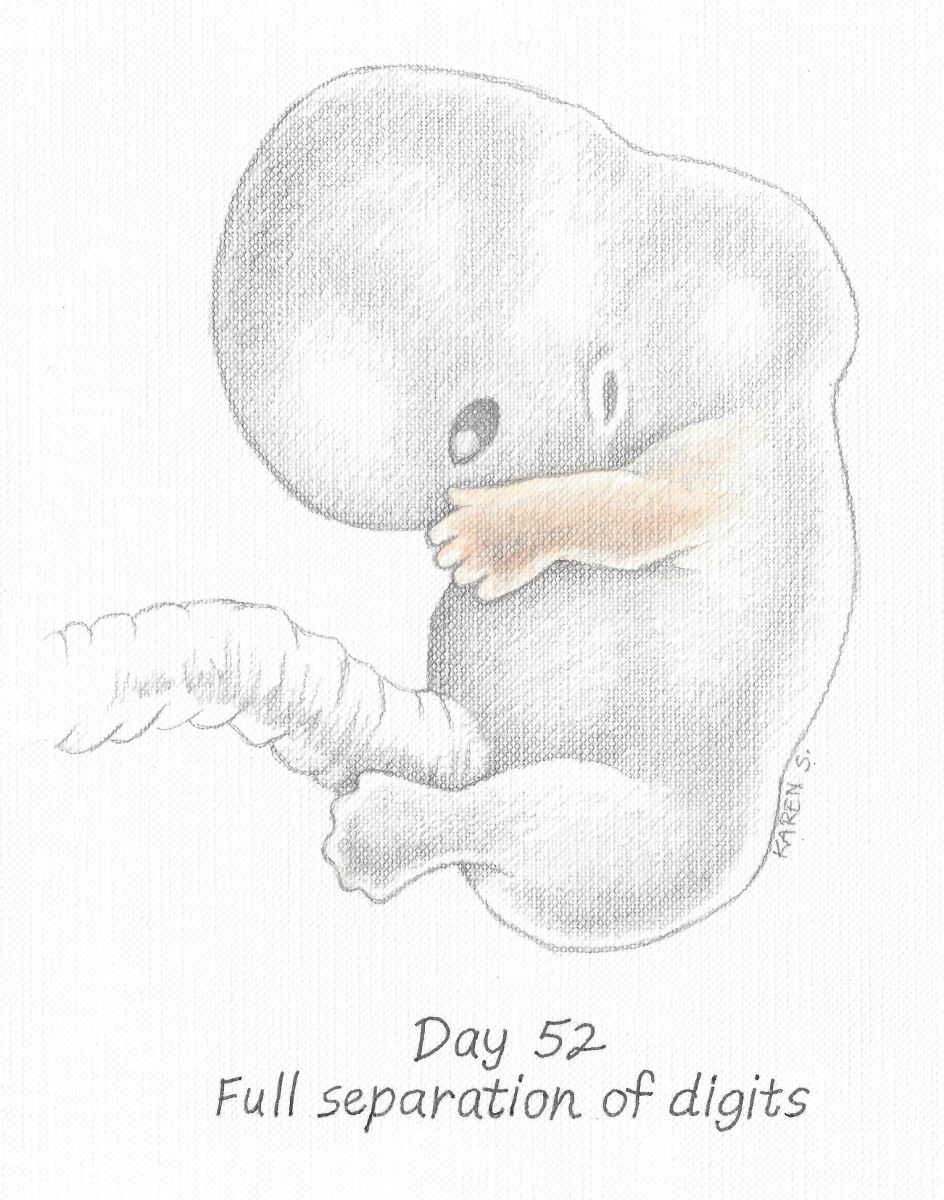
Day 52: Digits become separate, full separation of digits should be seen.
7 – 12 Weeks: Condensation of the mesenchyme begins to form cartilaginous lineage. The cartilage cells form a model of the limb bones which is replaced by bone. Vessels and nerves grow into the limb. Motor innervation originates from the schwann cells in the spinal cord. Muscles of the limb develop from mesenchymal cells. The muscles develop into 2 common masses, the dorsal and ventral masses.
12 Weeks: Bone transformation is nearly complete, except for the carpal bones. The carpal bones in the wrist do not ossify until 1 year after birth.
As the skeleton forms, myoblasts migrate to develop extensor and supinator muscles from the dorsal mass. The ventral mass gives rise to the flexor and pronator muscles
Axons grow into the limb buds along pathways. Each axon must decide whether to grow into the dorsal or ventral muscle mass. Tendons develop independent of the muscle bellies.
Cells are “assigned” characteristics so that tissues of bone, cartilage, muscle, and connective tissue are formed.