
Type IV Overgrowth
Osteochondromas are benign tumors of cartilage and bone projecting from the growth plates of bones. They can grow from any bone. Osteochondroma is the most common noncancerous bone growth. They usually occur between the ages of 10 and 30. Growth of the tumors generally stop once the growth plates fuse. The cartilage cap of the tumor can grow until age 30.
There are two types of Osteochondroma:
Solitary osteochondroma – A single tumor of osteocartilaginous exostosis growing out from the growth plate of a long bone. Most of the time the solitary type is not inherited.
Multiple osteochondramatosis – Multiple osteocartilaginous exostosis tumors can occur on the same bone or many bones. The number and location of the multiple tumors vary. With multiple tumors, the bones can grow abnormally. Most of the time multiple osteochondramatosis is inherited.
Symptoms of Osteochondroma
- Hard painless mass
- Mass does not move
- Many patient’s show no symptoms
- One leg or arm can be longer
- Irritation with exercise
- Soreness in nearby muscles
- Feeling of pressure with heavy exercise
- Outgrowths can decrease ROM if near a joint
- Outgrowths can cause numbness or tingling if placing pressure on a nerve
- Outgrowths can decrease blood flow if placing pressure on a blood vessel
Time to Play the Brain Game:
Q) Enchondromatosis is characterized by the presence of intra-osseous benign cartilaginous tumors. What is another term for this?
A) Ollier disease. This disease is common in the hands but is NOT a hereditary disorder. Additionally Maffuccis is a rare, non-hereditary disease that presents like Olliers disease but it is accompanied by multiple hemangiomas.
NOTE: Enchondromas are intraosseous tumors.
CASE EXAMPLE: MULTIPLE OSTEOCHONDRAMATOSIS
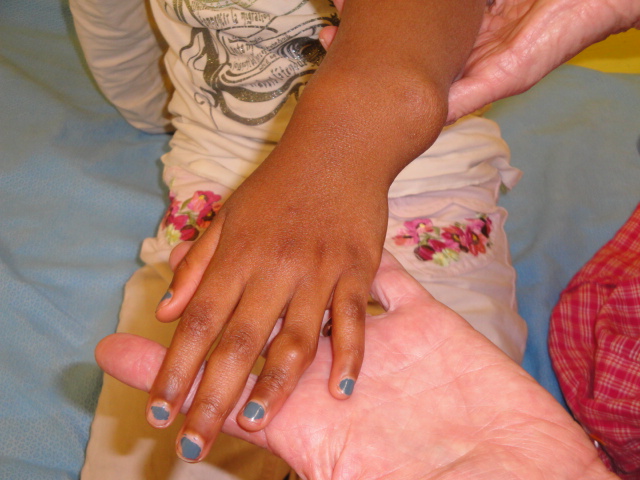
Osteochondromas can have a broad base of attachment onto the bone or they can be attached to the bone by a stalk.
Osteochondromas have a cartilage cap that merges with the epiphyseal area of the long bone. If the stalk of an osteochondroma fractures it can cause fibroblastic proliferation and formation of more bone. If a fracture at the stalk occurs, this will cause pain and inflammation that can be present for years.
Diagnosis of Osteochondroma:
- X-Ray shows a clear picture of the dense bone growth
- CT Scan if more detail is needed
- MRI is the most accurate and helpful if MD needs to differentiate an Osteochondroma from other lesions.
Time to Play the Brain Game:
Q) Osteochrondromas are benign osteocartilaginous outgrowths. True or False?
A) True
TREATMENT FOR OSTEOCHONDROMA
Treatment for Asymptomatic cases for osteochondromas:
- No treatment is necessary
- Regular follow up visits by medical doctor to check bone growth
- Biopsy to screen for cancer
Indications for Surgery for osteochondromas:
- Pain
- Outgrowth is causing pressure on a nerve or blood vessel
- Tumor has a large cartilage cap
- Tumor is limiting ROM and impairing function for the individual
- Tumor is causing growth disturbance
- Tumor continues to enlarge
Surgical intervention:
- Complete removal (excision) of tumors
- If the entire cartilage cap and any perichondrium is removed, there should be no reoccurrence
- The reported rate of reoccurrence is 2-5%. Reoccurrence is higher in cases of the skeletally immature, therefore surgery is recommended after skeletal maturity.