
Classification Type V: Undergrowth
Thumb hypoplasia can vary from an underdeveloped small thumb to complete absence of a thumb. In more than 50% of the cases both hands are affected. 80% of patients with thumb hypoplasia will have associated anomalies such as an absent radius, Holt-Oram, or VACTERL.
There are a few classification systems for thumb hypoplasia.
The 5 types of thumb Hypoplasia as described by Muller:
- Type I: Minor hypoplasia.
- All musculoskeletal and neurovascular
- Components are present, but they are undersized. The thumb is small. No surgical intervention is required.
- Type II: The Thumb and Index web space is narrowed and movement is restricted.
- The thenar muscles are underdeveloped or absent.
- There is ulnar collateral ligament (UCL) instability, thus there is an unstable MP joint of the thumb.
- Type III A:Thumb has a fairly stable CMC joint.
- Absence of AROM at the MCP or IP joints can also be present.
- Type III B:Thumb has an unstable CMC joint.
- Nearly absent thenar musculature and an underdeveloped MP joint.
- The 1st metacarpal bone is abnormal.
- Type IV: Sometimes referred to as a “floating thumb”.
- This thumb has no supporting connections from the thumb to the hand.The thumb is attached to the hand only by the skin and digital neurovascular structures.
- There are no thenar muscles and the thumb may only have a few rudimentary bones.
- Type V: Absent thumb
- .No thumb at all.
Time to Play the Brain Game:
Q) VACTERL is a disorder that affects many body systems, the Letters stand for what?
A) Vetebral deficits
Anal atresia
Cardiac deficits
Tracheo-
Esophaheal fistula
Renal abnormalities & Radial aplasia
Limb abnormalities
Surgical management of the hypoplastic thumb:
Regardless of the classification, the surgeon must assess each individual component of the thumb and determine which reconstructions will provide optimal thumb function and appearance. The goal for the surgeon is to correct the deformity, improve stabilization of the unstable joints, create joint mobility where needed and improve thumb function. In these cases, even after careful surgical reconstructions there is never a normal thumb. There is always some decreased function and strength.
Each case of the underdeveloped thumb has its own specific challenges for the surgeon.
Surgical Interventions for the hypoplastic thumb include:
- Release of the thumb & index web space, 1st web space deepening with Z-plasty.
- Stabilization of the MCP joint, Reconstruction of the UCL with FDS or free tendon graft, or fusion
- Opponensplasty, Opposition tendon transfer using FDS or Abductor Digiti Minimi to create opposition
- Pollicization: The surgical transfer of the index finger to improve grasp and tip to tip pinch. The index is shortened, realigned and placed at 45 degrees of Abduction and 100 – 120 degrees of pronation. Intrinsic muscles are transferred. The index finger will continue to be vascularized by 2 digital arteries. If performed while the child still has brain plasticity, the outcome for a successful pollicization should be good.
Case Example:
Carlos has type V thumb hypoplasia, Complete absence of his right thumb. Carlos’ clinical exam revealed that he has an intact FDP to his ring finger, but no flexor tendon function to his small finger. Carlos also presents with a fused right elbow and scoliosis.

Carlos gets provoked and picked on in school because of his right arm deformity. He defends himself by punching the “Teasers” with his right hand to show that his arm is functional. His mother is concerned about the trouble Carlos gets into while at school.
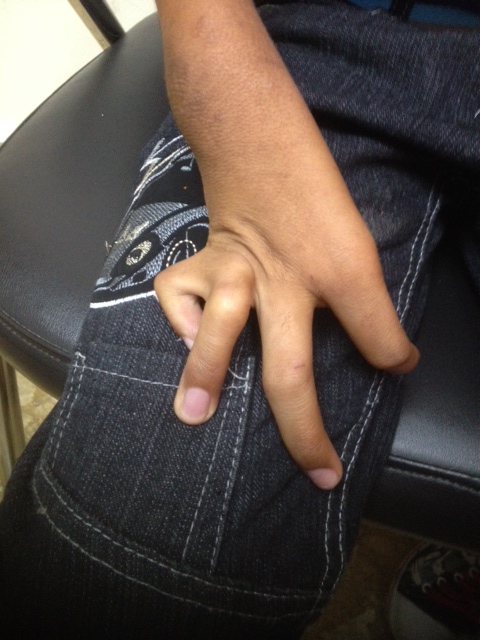
Carlos is a surgical candidate for a Pollicization.

In this video you can see how Carlos uses a Lateral pinch grip between his index finger and middle fingers.
>>insert video