
What are congenital hand deformities?
Congenital anomalies are deformities that are present at birth. Hand deformities can be extremely disabling as the child learns to interact with the environment and family. The degree of deformity can vary from minor to severe. Early consultation with a pediatric hand surgeon is vital for the treatment process to begin. Even if surgery is not an option at the initial visit, therapeutic intervention maybe necessary, and family education should begin immediately. When caregiver confidence improves, the child’s exercise frequency increases and family compliance improves.
There are seven groups of deformities that are accepted by the American Society for Surgery of the Hand.
Type I: FAILURE OF FORMATION
Problems occurring with the development of the parts. This occurs when the parts of the body stop developing while the baby is still in the development stages.
Examples: radial or ulnar club hand, cleft hand.

Example: radial club hand
BRAIN GAME QUESTION:
An ulnar clubhand is MORE common than a radial clubhand. True or False? — False… the radial clubhand is more common
Type II: FAILURE OF DIFFERENTIATION / SEPARATION
Failure of the bones or tissues in the hand from separating. This is a result of failure of the cells to differentiate (programmed cell death, Apoptosis).
Examples: syndactyly, congenital triggering, camptodactyly, clinodactyly, or kirner

BRAIN GAME QUESTION:
A syndactyly is the most common type of failure to separate. True or False? – This is indeed true! This deformity has a familial tendency.
Type III: DUPLICATION
Duplication of digits can occur with any digit, most commonly the small finger. Polydactyly is also commonly seen in the thumb. Central duplications are rare. Polydactyly is usually not a condition that affects functional use of the hand. For cosmesis, surgery is indicated. There are many different types of polydactyly.

Example: duplicate thumb
BRAIN GAME QUESTION:
What finger is most often affected by polydactyly? The little finger.
Type IV: OVERGROWTH
Macrodactyly or giantism is digital enlargement. Macrodactyly most commonly occurs in the median nerve distribution. It can be static or progressive. Common treatments are staged debulking, shortening procedures, wedge osteotomies to correct deviation, or partial amputations.
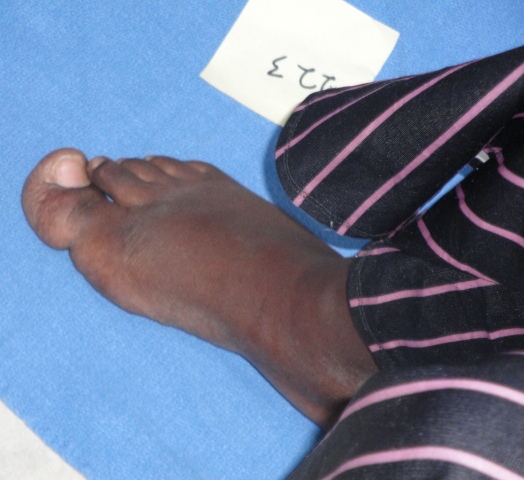
Example: macrodactyly of the great toe
Type V: UNDERGROWTH
Underdeveloped fingers or thumbs are commonly associated with many other congenital hand deformities, or it can be seen in isolation. Surgical treatment is not always required.
Underdevelopment can include: short digits, missing muscles, underdeveloped bones, or even complete absence of a digit or thumb. Example: Brachydactyly or hypoplasia

Example: short fingers
Hypoplastic thumbs may require surgery. True or False? – True. An opposable thumb will allow functional use of the hand and therefore underdeveloped thumbs may warrant surgery to facilitate an opposable thumb.
Type VI: CONSTRICTION BAND SYNDROME
This occurs when a tissue band forms around a digit or limb. Annular bands of tissue encircle the limb affecting blood flow and normal growth. As the child grows, these bands do not accommodate. Ring constrictions are caused from deficits in the amnionic sac.
.JPG)
Example: Constriction band of right leg and right digits
Type VII: GENERALIZED
This includes generalized problems with the skeletal system that are rare and are a complex group of problems.
BRAIN GAME QUESTION:
Most congenital anomalies are of multi factorial causation, this is due to a combination of environmental and genetic factors. True or False? – True (can be combined nutritional deficiencies and exposure of environmental pollutants and/ or genetic)